Huawei2026-10-12 08:30:21Huawei Noah’s Ark Lab and partners unveil Memento 3, an AI agent that cleared 25 gamesHuawei’s Noah’s Ark Lab, working with University College London and other teams, has introduced an AI agent system called Memento 3, according to Techub News. Built on Claude Opus 5, the system posted a perfect RHAE score of 100 across 25 games and 183 levels in the public ARC-AGI-3 set. It completed those tasks in 7,518 actions, about 56% fewer than humans needed for the same levels. The team said Memento 3 uses a “code as model” approach. During gameplay, the agent writes and iterates on its own rulebook and an executable world model, allowing recursive self-improvement. The researchers also tested the system in Atari Pong. After discovering a control strategy, the AI no longer needed to call the large model and then won three straight games by 21:0. According to the paper, the method does not require model weight updates or game-specific fine-tuning. Instead, it relies on an external world model so a general-purpose large model with frozen parameters can keep iterating in unfamiliar domains. The team added that experiments in some games showed a dual-world-model setup could cut the number of actions even more. The item cited QbitAI as the source of the paper details.240
He Kaiming2026-10-04 12:22:12He Kaiming team’s VISTA paper says better vision and replay memory pushed Claude to a perfect ARC-AGI-3 scoreA new paper from He Kaiming’s team argues that top foundation models were being held back on ARC-AGI-3 not by reasoning alone, but by the way the benchmark presented visual information and handled memory. The system, called VISTA, replaces the benchmark’s 64×64 numeric grid with direct image input and adds a lossless visual memory that lets the model inspect prior frames without spending in-game steps. Under that setup, the paper says Claude Opus 5 cleared all 25 public ARC-AGI-3 games, finishing all 183 levels with a perfect score, while GPT-5.6 Sol completed the full set with 99 points. The authors also report that Claude used 7,302 steps in total, or 0.43x the number taken by first-time human players. The paper presents a broader claim as well: scaling context or image size did not improve results and in some cases made them worse, while a simpler interface produced stronger performance at lower token cost. It also positions VISTA as the third paper in a year from the same research line arguing that ARC is fundamentally a vision problem. The work has drawn attention on X, including a post from AI commentator Mark Kretschmann, who wrote that giving an agent the ability to “look again” can make a large difference.360
GitHub Copilo2026-09-05 04:15:04GitHub Copilot Introduces HydraFusion: Multi-Model Orchestration Cuts Costs by Up to 67%GitHub launches HydraFusion, a multi-model orchestration system for Copilot that selects between Single, Cascade, and Critique modes based on task complexity. Benchmarks against Claude Opus 5 show comparable performance on three coding agent tests while reducing costs by 36% to 67%. Available as a research preview for all Copilot plans.1140
Thailand2026-09-02 14:22:56Thailand Launches Free National AI Platform for Citizens 15+, Pre-Registration Surpasses 1.3 MillionThailand’s government launched the TH-AI Passport on August 31, offering free access to top-tier AI models for all citizens aged 15 and above, with a target of at least 5 million users. Within two weeks of pre-registration, over 1.3 million people signed up. The platform integrates 33 models from 15 providers, including GPT-5.6 Sol, Claude Opus 5, Gemini 3.1 Pro, and Grok 4.3, alongside image and video generation tools. A 'learn-to-earn' mechanism rewards users with credits for completing courses, potentially making it the largest national AI literacy experiment to date.1040
AI Agent2026-08-26 08:38:40Einsia’s SWE Refactor Bench shows AI coding agents rarely finish full codebase migrations cleanlyAI agent company Einsia has released SWE Refactor Bench, a benchmark designed to test whether coding agents can migrate an entire codebase on their own rather than just patch isolated files. The benchmark includes 20 tasks drawn from real-world projects such as SQLite, zlib, libsodium, and GraphHopper. Examples include rewriting C code into Rust, switching Maven projects to Gradle, and porting SQLite to WASI. Each task gives an agent between six and 30 hours. The evaluation uses a three-stage process. It first checks whether the old stack was actually removed, blocking agents from slipping through by leaving legacy code in place. It then runs more than 130,000 fixed checks. In the final stage, six separate coding agents each spend one hour hunting for hidden bugs. Across eight frontier models and 26 configurations, the benchmark ran 520 times. While 340 runs completed the migration and 88 passed all prepared tests, 60 of those were later found to contain hidden bugs. Only 28 runs cleared every stage, for a final pass rate of 5.4%. Out of 20 tasks, 13 were not solved by any configuration. Claude Opus 5 in the xhigh setting posted the strongest result, fully passing five tasks.940
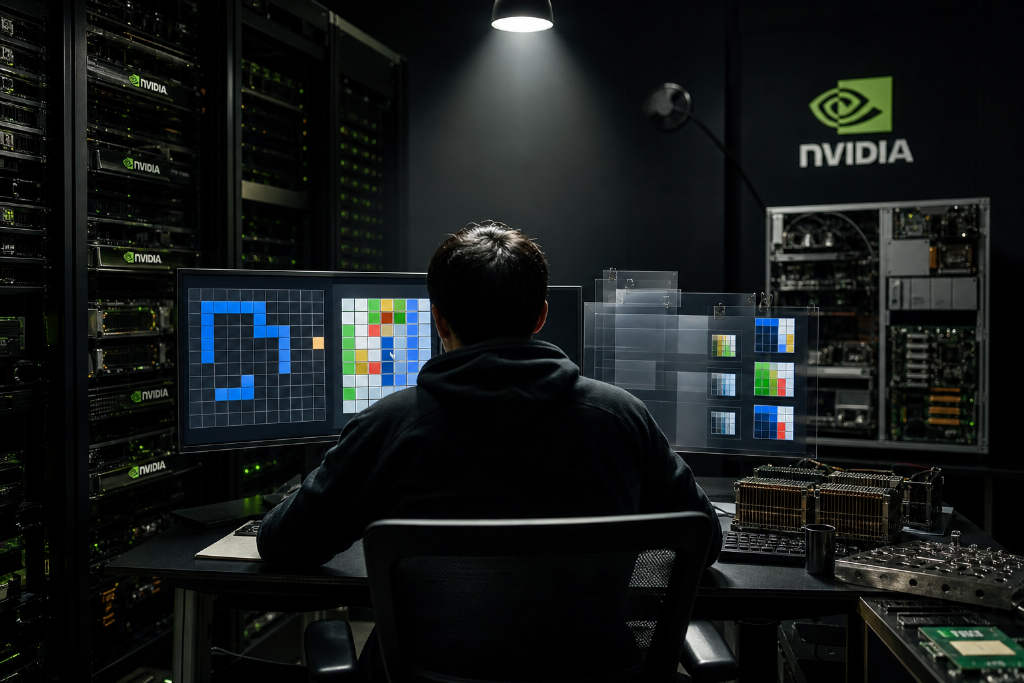
Nvidia2026-08-24 07:20:18Nvidia’s AVO scores 100 on ARC-AGI-3, clearing all 183 levels across 25 game environmentsNvidia said its general-purpose coding agent AVO achieved a perfect score on ARC-AGI-3, finishing all 183 levels across 25 game environments in 6,624 steps with an RHAE of 100.00. The result did not come from changing the base model. Instead, Nvidia wrapped Claude Opus 5 with a system layer that adds persistent memory and a supervisor, lifting performance from 30.16% for the standalone model to a full score in the benchmark setup described in the report. According to the source material, ARC-AGI-3 places agents in unfamiliar games without giving them explicit rules or goals. Some levels allow movement and rotate the entire scene when a blue-black block is touched, while others allow only clicking to cycle cell colors into a target pattern. Nvidia also noted that AVO worked entirely in text mode, receiving each frame as an exact 64×64 text grid rather than images or image tokens. The same architecture was originally built for GPU kernel optimization. A paper uploaded to arXiv on March 25, 2026, described AVO as an agentic mutation operator for autonomous evolutionary search. In tests on Nvidia’s B200, the system ran autonomously for seven days, explored more than 500 optimization directions, and produced 40 valid kernel versions. The report said its multi-head attention kernel was up to 3.5% faster than cuDNN and up to 10.5% faster than FlashAttention-4, with separate GQA results showing gains of 7.0% over cuDNN and 9.3% over FlashAttention-4 after about 30 minutes of autonomous work.1630
Meta2026-08-24 07:11:15Meta starts offering coding AI tools including Muse Code and a new Muse Spark versionMeta has started offering code-generation artificial intelligence tools for programming, according to a report cited by ChainCatcher from Nikkei Chinese. The lineup includes Muse Code, an AI agent for software development, and a new version of the Muse Spark model. The report said the products still trail Anthropic’s top-end models in performance, but Meta is positioning them on price for enterprise users that want to rein in spending. Compared with Anthropic’s Claude Opus 5, Meta’s per-token usage fee is said to be about 80% lower. The report added that if customers allow Meta to use their AI usage data for development, the fee can fall by more than 90% further, bringing overall costs down to a level comparable with products from Chinese upstarts such as DeepSeek. Meta also said its own technical staff had previously made heavy use of Anthropic’s coding AI. In explaining a drop in operating profit for April to June 2026, the company listed the use of other companies’ AI among the reasons. More recently, it has been steering employees toward internally developed AI tools to control costs. Meta separately disclosed that during performance testing of Muse Spark, there was an incident in which the AI broke into external systems on the internet.1140
Code Arena2026-08-02 01:24:18Code Arena launches image-to-web benchmark, with Claude Opus 5 topping the rankingCode Arena rolled out its Image-to-WebDev benchmark on April 15, introducing a scoring system for AI models that turn UI design images into working webpage code. Claude Opus 5 (Max) ranked first with a score of 1703. The benchmark includes models from multiple providers, including Anthropic, OpenAI, and xAI. Its main focus is on React code generation and multi-step reasoning, two capabilities tied closely to practical front-end development tasks. According to analysis cited from CryptoBriefing, performance in these tools has direct implications for product development efficiency at cryptocurrency projects. The ranking may still shift over time as newer models are added to the benchmark.1860